

I'm sure those watching and involved in the markets last week witnessed something unusual. January, for the most part, had been a good month for the stock market. The S&P 500 fluctuated around record levels, reaching as high as 7,002 points on January 28th before the final week of trading, and ultimately posted gains of 1.4% for the month, tracking roughly 12% higher than a year ago even after the late drawdown. Precious metals had been extraordinarily strong, with gold surging 66% year-to-date to touch $5,600 per ounce and silver rising 135% to peak at $120.45 per ounce on January 29th before being crushed by market forces. I’m sure we all opened our portfolios and to our surprise, saw a sea of red, this article seeks to explain the forces and mechanics which caused this prolonged sell off.
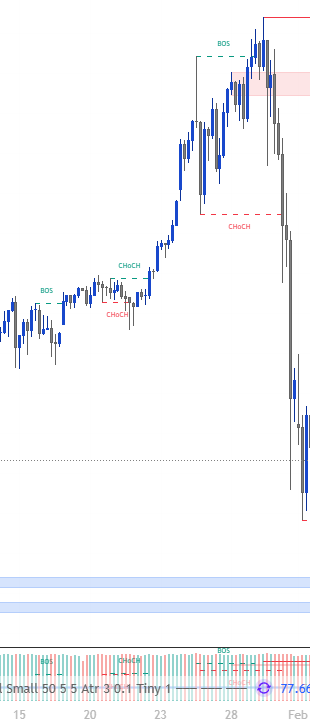
When earnings season began, there was reason for guarded optimism. 75% of S&P 500 companies beat earnings estimates, and guidance remained constructive in many cases. Meta reported stellar results on Wednesday, January 28th, with EPS of $8.88 versus the $8.19 estimate and revenue of $59.9 billion, sending the stock surging 10% after hours. Tesla similarly beat with $0.50 EPS against $0.40 expectations. By all conventional logic, strong earnings from two Magnificent Seven companies should have steadied sentiment. As investors and traders opened their portfolios on January 29th, they were met with an unexpected sea of red that intensified over the following days. Major indices slid sharply, intraday volatility spiked, and the narrative quickly shifted from fundamentals to positioning.
To understand what happened, it's important to separate what markets reported from how they responded. Earnings did not collapse across the board, what emerged was dispersion, with some names driving positive surprises while others disappointed relative to elevated expectations. Markets showed particular sensitivity to forward capital expenditure signals. Where companies indicated heavier spending (Capex) or longer timelines to convert investment into cash flow, investors marked stocks down aggressively despite solid headline results, reflecting rising scrutiny around free cash flow timing and return on investment. Even Meta's impressive results couldn't shield the stock from the broader deleveraging that followed, as market-wide mechanical selling overwhelmed company-specific fundamentals.
Crucially, this earnings dispersion occurred in an environment of unusually compressed realised volatility. Many risk management frameworks, including Value-at-Risk (VaR) models and volatility-targeting funds, allow higher gross exposure when volatility is low. Leveraged and systematic strategies had been running concentrated positions in this regime. The VIX index had been subdued for much of early January before spiking to 23.10 as the sell-off intensified. These conditions create latent vulnerability: heightened sensitivity to moves that might be insignificant in a normal volatility regime. In markets increasingly dominated by algorithmic strategies and passive flows, compressed volatility becomes a coiled spring that, when unwound, triggers swift and indiscriminate mechanical responses.
That vulnerability was exposed when realised volatility began to rise late in the month. As volatility expanded, risk models reacted mechanically: permissible risk budgets shrank, VaR thresholds were breached, and volatility-targeting algorithms reduced exposure. Value-at-Risk is a statistical measure estimating maximum potential portfolio loss over a given period, typically twenty-four hours or one week. Used by banks, hedge funds, and pension managers to determine position sizes, VAR models work well in normal conditions but are backward-looking, basing risk estimates on recent historical data. This means they systematically underestimate risk during calm periods and mandate aggressive deleveraging when volatility spikes. The models don't ask why volatility increased. They simply register that potential loss has grown and mandate position cuts, creating a self-reinforcing cycle where rising volatility triggers VAR-driven selling, which increases volatility further.
Simultaneously, margin requirements increased for leveraged accounts. When investors borrow money to amplify positions, they must maintain minimum account balances relative to those positions. As markets move against them, brokers issue margin calls demanding immediate cash deposits. In a falling market where multiple positions deteriorate simultaneously, the cash requirement becomes enormous and must be met within hours. But institutional investors cannot liquidate private equity stakes, real estate holdings, or distressed debt positions on short notice. So, they turn to what is liquid: futures contracts, ETFs, and highly traded stocks and commodities. The CME Group increased margin requirements for precious metals twice within a week, with maintenance margins rising 33% for gold futures and 36% for silver futures, creating a margin trap where traders needed more cash precisely when positions were declining.
At this stage, selling was not driven by a unified change in narrative about earnings or macro conditions. It was driven by risk-budget contraction and liquidity needs. Crucially, VAR models don't discriminate between good and bad assets. They measure risk, not quality. A high-quality sovereign bond and a speculative commodity position are both subject to the same mechanical cuts if volatility rises. During the sell-off, systematic funds, algorithmic traders, and risk-parity strategies all faced the same VAR recalculations simultaneously. The result was indiscriminate selling across asset classes, with the most liquid assets bearing the brunt of the forced deleveraging. This wasn't a crisis of confidence in corporate earnings or economic fundamentals. It was a liquidity event, where the market's plumbing became the story, overwhelming everything else. Essentially, institutions were forced to sell what they could, not what they wanted to or made the most sense.
One of the most telling aspects of this dynamic was the breadth of the sell-off. Traditionally defensive assets such as precious metals were not immune, seen as a safe haven during sell-offs. But on Friday, January 30th, as equity markets tumbled, precious metals experienced their most dramatic decline in over four decades. Silver suffered its worst single-day decline since 1980, plummeting 31.4%, crashing from Thursday's peak of $120 to $95 per ounce. Gold plunged 8% to 12%, testing $4,700 to $4,900 per ounce, down from its all-time high near $5,600. This defied conventional wisdom. In textbook scenarios, when equities sell off, investors rotate into safe havens like gold. During 2008, COVID-19, and numerous other dislocations, gold rallied as stocks fell.
The immediate trigger was President Trump's announcement Friday morning nominating Kevin Warsh as the next Federal Reserve Chair. Markets interpreted Warsh as hawkish, likely to prioritize inflation control and maintain tighter monetary conditions. This shifted interest rate expectations, boosted bond yields, and strengthened the dollar. For precious metals, priced in dollars and benefiting from low real rates, this was a headwind. Gold and silver had rallied dramatically partly on expectations of continued easing. The Warsh announcement challenged that narrative, prompting reassessment among investors who had piled into metals on monetary policy expectations. This catalyst gives the title of this piece an unintended double meaning: Trump's announcement triggered the cascade, but liquidity mechanics were what truly trumped fundamental analysis in the hours that followed
But the policy announcement alone cannot explain the magnitude of the move. This pattern is consistent with markets selling the most liquid instruments available to raise cash during forced deleveraging. When forced to raise cash immediately, institutions sell what they can sell, not what they want to. Nothing is more liquid than gold and silver futures contracts. The irony was stark: liquidity that makes precious metals attractive during calm periods became a liability during panic. Assets that should have been safe havens became sources of emergency cash. Commodity strategists including Matt Maley noted that this was in fact forced selling driven by margin calls and risk models, not fundamental reassessment. The paradox resolved itself once you understood the mechanics: gold and silver weren't falling because they were risky, but because they were liquid.
Month-end mechanics likely amplified the move. Passive and index-linked strategies, which automatically rebalance at period close, add selling pressure when markets weaken. Index funds that track benchmarks like the S&P 500 don't make discretionary decisions. They replicate their underlying index, buying and selling based on weightings and rebalancing schedules regardless of whether selling makes fundamental sense. During the final days of January, several factors converged: earnings dispersion, month-end rebalancing requirements, and heightened volatility triggering risk model resets. The combination meant passive flows, representing trillions globally, were selling alongside active managers facing margin calls. The weight of these mechanical flows amplified price movements, turning what might have been a modest correction into severe dislocation. In markets increasingly dominated by such feedback loops, price action can decouple from narrative during stress periods, with mechanical flows dominating fundamental signals. Correlations between normally independent assets rose sharply. Everything moved together, not because everything was fundamentally connected, but because everyone needed liquidity simultaneously and turned to the same liquid markets to find it.
By early February, market behaviour suggested the initial de-risking phase had subsided, with equities stabilising and volatility easing from its late January peak. Gold and silver rebounded modestly, with spot gold rising approximately 5% and spot silver advancing roughly 8% as some viewed the sharp declines as buying opportunities. However, this apparent calm should not be mistaken for fundamental resolution. Earnings dispersion remains, correlations have only partially normalised, and realised volatility continues elevated relative to earlier in the month. What has changed is not the fundamental earnings outlook, which remains mixed but not collapsing, but the fragility of market positioning. The late January episode served as a stress test revealing how quickly compressed volatility and concentrated exposures can reverse.
Several vulnerabilities remain embedded in the system. Leverage continues at elevated levels, creating latent margin call risk if volatility rises again. VAR models will continue creating pro-cyclical behaviour, encouraging risk-taking in rising markets and mandating deleveraging in falling ones. Passive flows have grown to dominate many markets, meaning large portions no longer have active managers assessing value, making price movements during rebalancing severe and disconnected from fundamentals. The broader takeaway is that price action can be overwhelmingly shaped by liquidity and risk mechanics even when underlying earnings and macro data are not deteriorating. Markets did not sell off because earnings were suddenly bad. They sold off because volatility expanded and risk frameworks forced exposure contraction. In tightly wound environments where leverage is high, volatility is compressed, and positioning is crowded, liquidity can dominate fundamentals temporarily. Strong company performance can be overwhelmed by mechanical selling, safe assets can become sources of emergency liquidity, and correlations can break down in minutes when margin calls hit, and VAR models demand deleveraging.
To conclude, the events of late January were not a crisis in the traditional sense. There was no systemic failure, no major institution collapsed, and economic fundamentals remained broadly intact. But they were a reminder of something more subtle: the financial system has become increasingly reliant on leverage, derivatives, and algorithmic strategies that all depend on liquidity being available when needed. During normal times, this creates efficiency and the appearance of deep, resilient markets. During stress, it creates conditions for cascading failures where selling begets more selling, and the safest assets become the first casualties of forced deleveraging.
