
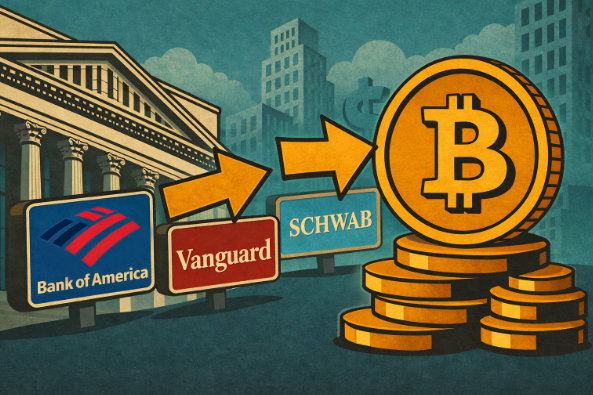
That illusion officially fell apart this week.
On Tuesday, Bank of America announced a major shift. Its financial advisors are now allowed to recommend Bitcoin investments to clients. At the same time, Vanguard, historically the strictest critic of the industry, opened its platform to allow third-party crypto ETFs. This isn’t just a new product update. It is a signal that the dam has broken. The story of "institutional hesitation" is over, replaced by a scramble to catch up.

To understand why this is happening now, we have to look at how these massive companies operate. For decades, the wealth management industry was built on a model of "fiduciary paternalism." This is a fancy way of saying that banks believed they knew what was best for their clients, and their job was to filter out the noise.
In this traditional system, an investment was only considered "real" if it fit into specific boxes. Advisors looked for dividends, cash flow, and quarterly earnings reports. Because Bitcoin and other cryptocurrencies don’t have a CEO or pay dividends, they didn’t fit the model. They were invisible to the old way of calculating value.
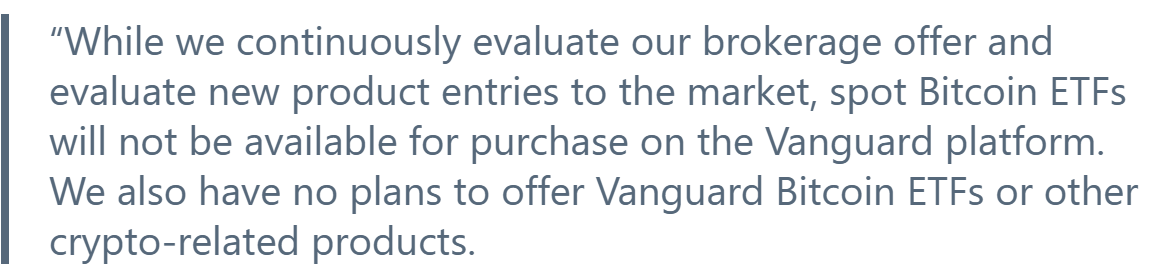
For a long time, firms like Vanguard used this mismatch to justify a hard "no." They told clients that because crypto couldn’t be valued like a share or a bond, it wasn’t an investment at all. The system was designed to keep money circulating inside the safe, predictable world of traditional finance.
The problem with this approach was that it ignored reality. The "hidden flaw" in the exclusion strategy was that clients didn’t stop wanting crypto just because their bank said no. They simply went elsewhere.
The flaw was magnified by the fact that other banks had already started moving. As Morgan Stanley noted when they removed restrictions for their advisors in October, and Wells Fargo Advisors did by placing spot Bitcoin ETFs on their recommendation list months ago, the industry was already shifting. Vanguard and BofA were effectively the last major players trying to hold the line, and this week, they realised that the line could no longer hold.
We are witnessing a quiet revolution in how money enters this market. In the past, crypto prices were driven by retail traders, regular people buying on apps, often driven by hype. This money is "flighty." It comes in fast when prices go up and leaves fast when prices crash.
The shift to platforms like BofA and Vanguard introduces what analysts call "sticky flows." When a financial advisor builds a retirement plan for a client, they don't day-trade. If they allocate 2% to a crypto ETF, that money tends to stay there for years. It gets rebalanced automatically, regardless of the news headlines.
Why is this happening now? The answer lies in regulation. For years, banks were terrified of the "Wild West" reputation of crypto. They were worried about getting sued or breaking rules.
The backend plumbing has improved. Banks like Citi are planning to launch their own custody services, meaning they will hold the digital keys themselves. The "regulatory wave" has turned from a tsunami of enforcement into a calm tide of clear rules, making it safe for the giants to enter the water.
The numbers behind this shift are staggering. We often talk about crypto market caps, but we rarely compare them to the sheer size of the traditional wealth management industry.
Vanguard and Bank of America combined oversee roughly $13 trillion in assets. This is a mind-boggling amount of money. Even a tiny shift in this mountain of capital changes the landscape. If advisors move just 1% of that $13 trillion into crypto, it would represent $130 billion in new buying pressure, more than double all the money that has flowed into crypto ETFs so far.
This transformation suggests a future with less volatility. As this massive, slow-moving institutional money enters the market, it acts as a stabiliser. The days of Bitcoin crashing 20% in a single hour may be fading, replaced by the slower, steadier movements of a mature asset class.
The era of the "crypto blockade" is over. The illusion that major financial institutions could simply ignore the digital asset class has been shattered by the reality of the market.
Vanguard, Schwab, and Bank of America have not capitulated because they wanted to; they did it because they had to. The friction that kept trillions of dollars on the sidelines has been removed. For the average investor, the question is no longer if their bank will let them invest in the future of finance, but how that investment will be managed. The gatekeepers have unlocked the gates, and the financial world is walking through.