
.png)
• Currency Depreciation Risk: The rupee has historically weakened against major currencies, creating currency risk for foreign investors, even though India remains one of the more stable emerging economies.
• Economic Volatility vs Growth Opportunity: India offers strong innovation potential and high interest rates, but still faces inflation, corruption, and import dependence.
• Long Term Outlook: If India boosts exports, reduces import reliance, and builds on its growing start up culture, the rupee could stabilise and make early investment more rewarding.
The downside to this is that the value of the Indian rupee has historically depreciated against the British Pound and the US Dollar. Therefore, investors need to consider whether it is still worthwhile pursuing such investments when they have easy access to funds such as the S&P 500, which many investors predict will continue to grow at 8% per year for the next 40 years, according to historical figures. For the Indian market, the depreciation of the rupee attracts foreign buyers since their products and services can remain more competitive against other economies.
As a result, investors need to consider what there can be a realistically superior return in such a volatile market with typically high inflation and government corruption. Investors must consider whether this can still beat the gold standard of the S&P 500, after factoring in this currency risk to their investments.

From 1947 to 1990 the rate of devaluation was relatively stable, and we can see a consistent loss of value in the Indian rupee against the British pound. One may think that going into 1947 the Indian rupee never had a chance to succeed. With colonial powers at play it was always at the mercy of others, with no real decision making powers to protect its currency. It was exposed to disrupted trade, huge war spending, and the high inflation that followed.
After 1947 the Indian economy had to restart itself from a weak position, with a limited export market and extremely small foreign reserves, while domestic demand remained strong. Many would argue that India was still at the mercy of foreign players. In addition to this India experienced multiple wars between 1950 and 1990, which again left the country dependent on international lenders. These lenders often pressured India to devalue the rupee in exchange for foreign aid. This may explain why the currency experienced continuous devaluation throughout this period.
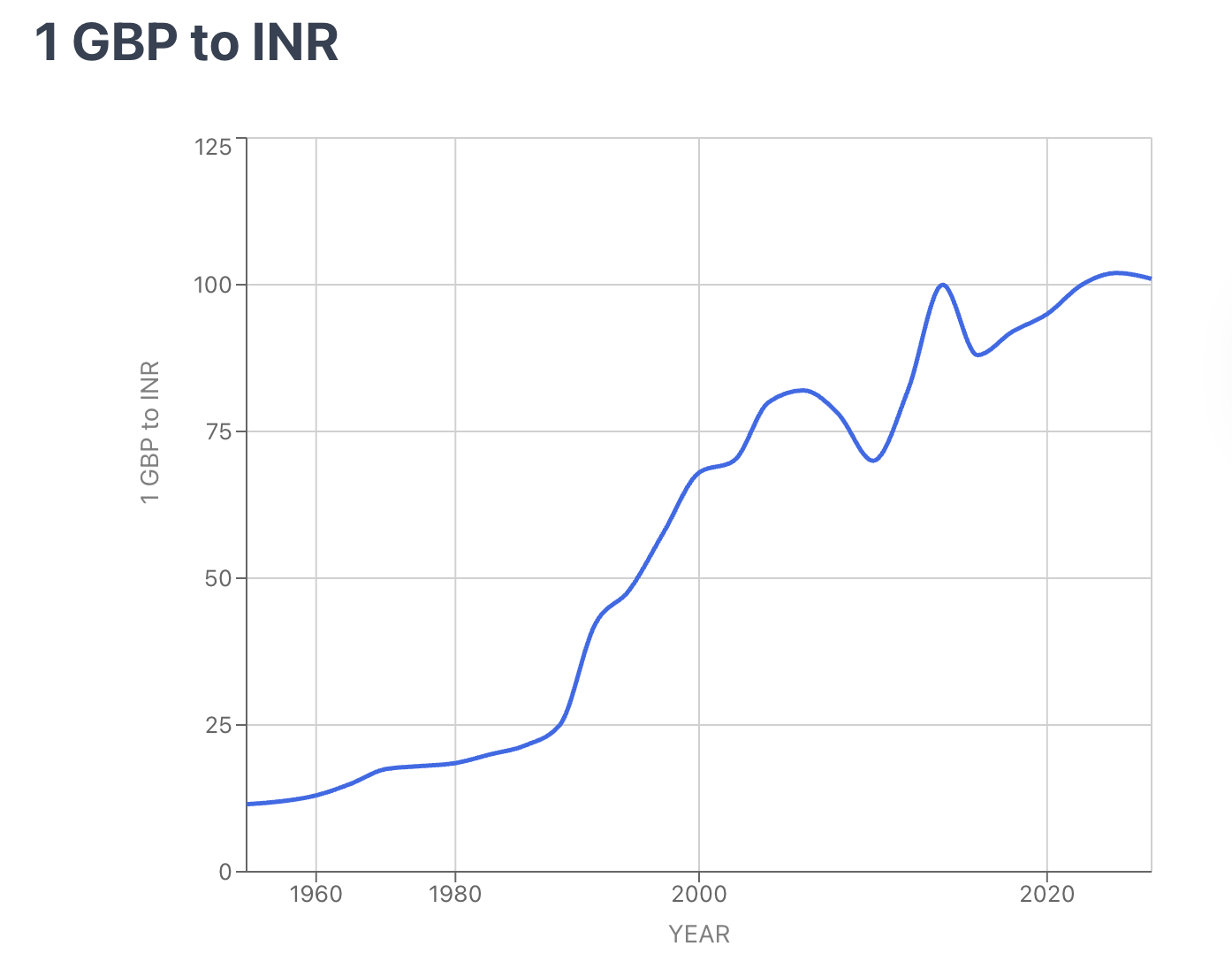
After 1990 the Gulf War created further difficulties, leading to a sharp rise in oil prices and dangerously low foreign reserves. India once again needed a bailout to avoid defaulting on its debt. In exchange India agreed to open up its economy and allow a market determined exchange rate. This caused a further and more pronounced devaluation of the currency in the short term, although conditions began to improve in the longer term.
Although this shift brought rising import bills and larger trade deficits, the early two thousands saw the Indian economy accelerate. This was the era of the global tech boom, and India experienced rapid growth in its IT sector. Since the rupee was relatively cheap, foreign investors were incentivised to invest in India, creating a steady inflow of capital. There have still been turbulent periods, and it is important to remember that India remains an emerging economy.
More recently, according to the BBC, September marked the first full month of Trump’s fifty percent import tariff on India. India appears still to be exposed to the actions of foreign players, especially given that many of its major tech clients come from these same economies. In addition to weakening employment prospects within India, there have been tighter immigration restrictions in both the UK and US. This has resulted in fewer Indian migrants working abroad and sending money back home to be spent locally, creating another pressure on the Indian economy.
If we forget about investing, even normal savings in economies like India can offer favourable interest rates in comparison to US or UK bank accounts, especially in the pre-COVID era, where Indian bank accounts could be offering figures like 7%, while UK bank accounts would typically offer less than 1%. Even now while you may find a UK bank account paying 4%, there are Indian accounts paying upwards of 10%. Even if we assume a devaluation of 5% per year, this is still more favourable for a foreign investor. The risk an investor will take on here is whether they can expect the Indian Rupee to stabilise, which it has not done since 2000.
If India reduces its dependence on imports, i.e., the dollar, we can expect to see this stabilisation. In addition, India has a massively growing start-up culture, which does reflect on a stabilising rupee and increased exports. Additionally, with the current political landscape and India forging trade deals with foreign powers, this indicates a stronger future export market.
One must consider that economic phases are such that there are always periods of downturn and periods of upturn with an overall upward trajectory. This means that theoretically, this historic devaluation should be followed by at least some stability over the next decade. Therefore, if one is to believe India can strengthen its global political landscape along with the creation of successful local entrepreneurs (which low barriers to entry locally can help with), this may be a good time to get into the market before it makes its transition from a developing economy into a global powerhouse.