
.png)
For much of the past decade, these trends have developed along separate paths.
Recently, this separation has begun to narrow. AI systems now sit at the centre of both economic and political attention, powering everything from search engines to financial markets. Yet as these models have grown more capable, control has become increasingly concentrated, shaped by access to data, computing power and capital.
At the same time, blockchain has continued to evolve quietly in the background. Beyond its speculative markets, it functions as a shared system for moving value and verifying data. What began as an alternative financial system is now being tested as infrastructure beyond finance.
As these technologies mature, their overlap becomes increasingly lucrative. The push to combine AI with blockchain reflects broader tensions between scale and transparency, efficiency and control - conflicts that are starting to surface across both fields.

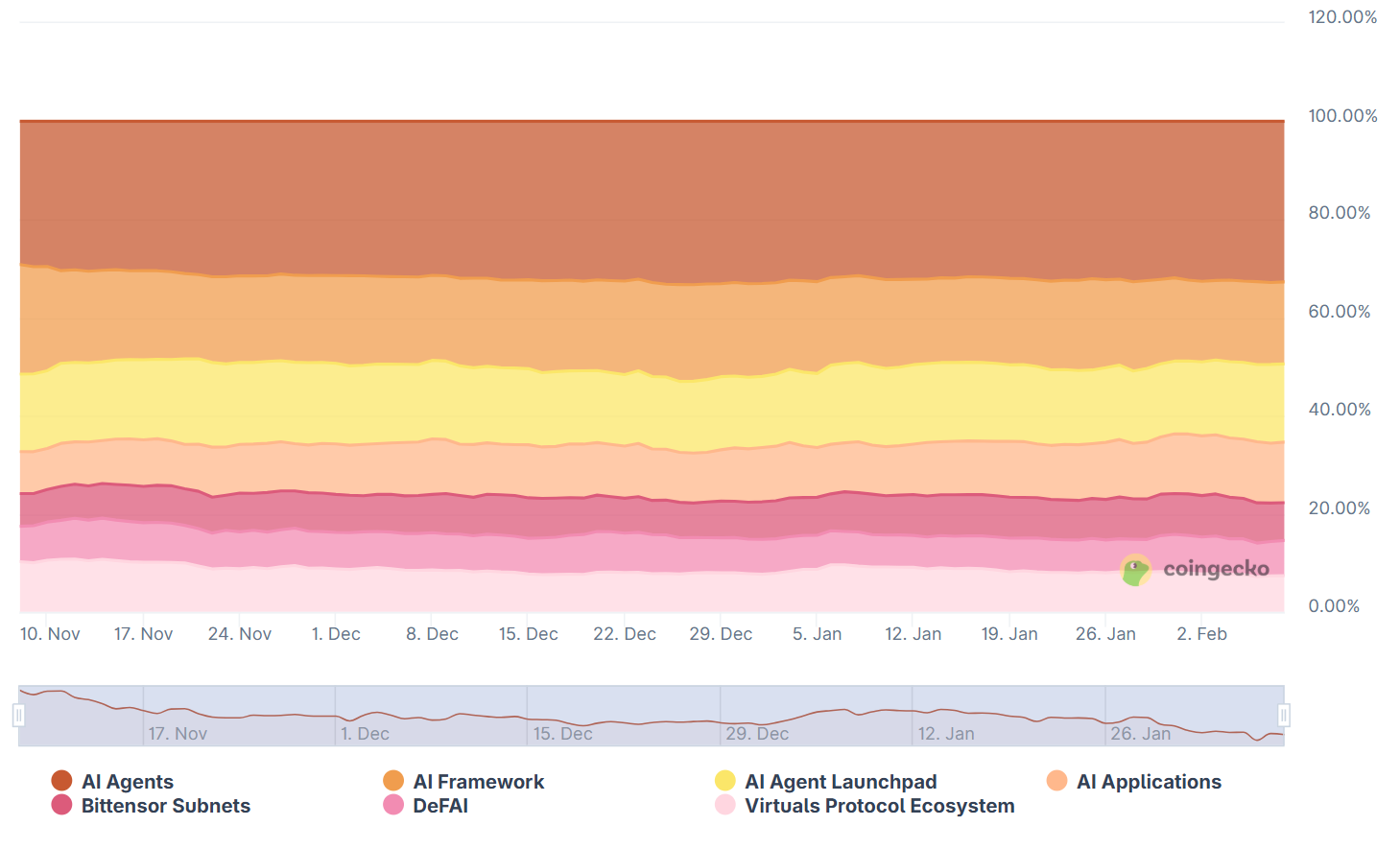
Between 2023 and 2024, ‘AI tokens’ became one of the fastest-growing categories within crypto. The sector surged tenfold from $2.7 Billion in April 2023 to $27 Billion by mid-2025. New projects are launched daily, each claiming to combine AI and blockchain infrastructure. Investors rushed in, desperate to position themselves inside the next major trend.
But the category itself wasn’t defined. Some tokens funded compute networks whose processing power was rented out for AI training. Others were governance tokens for agent platforms or data marketplaces. Many claimed to be ‘AI-powered’ trading tools. And some were just tokens with some AI branding, riding the hype.
By November 2024, over 21,000 agent tokens were launched from platforms like Virtuals Protocol in a single month, with 1000s more appearing daily.
The rally wasn’t driven by usage. Most projects actually had minimal activity, few active users, and extremely vague roadmaps. What they had was timing. AI had become the largest narrative in technology, and crypto provided a way to price the conviction.
Tokens became blind bets on a trend rather than on any specific product. Investors weren’t concerned about better AI infrastructure or more intelligent agents. They were betting that something at the intersection between AI and crypto would become important. They wanted exposure before it became obvious which projects would be victors.
This perfectly mirrored earlier cycles. Just as ‘DeFi summer’ saw huge amounts of yield farming tokens launch within months, or the NFT boom turned profile pictures into multi-billion dollar markets, the AI token craze reflected crypto’s ability to rapidly monetise emerging trends.
Prices moved faster than the technology could develop, causing the gap between market valuations and products to grow wider.
By early 2025, this gap began to close - quickly. As the market cooled and attention turned to the projects actually delivering utility, valuations corrected. Tokens without genuine usage or clear proposals lost most of their market value overnight. The projects that survived were the ones building infrastructure that people were using.
This trend did not signify a failure in how AI and crypto could work together. It was a reminder that markets price stories far before they deliver value.
Prices climbed long before most projects had launched anything, and when the rally ended, the platforms with real users were left standing.
For most of Blockchain’s history, participants were exclusively people. Wallets belonged to individuals and institutions, transactions required human approval, and every on-chain action could be traced back to someone making a decision.
This assumption is starting to break down. AI systems are now in control of wallets: signing transactions and interacting with decentralised applications (dApps) directly. They’re not just tools people use to engage with networks - they’re becoming participants themselves.
The technical shift is straightforward. AI can control a private key just as easily as a person can. Once it does, it's able to send payments, execute trades, or interact with smart contracts without the need for human input.
Traditional finance requires custom APIs and integrations for automated transactions. Blockchains provide this capability natively - any software with a private key can interact immediately.
This matters because crypto provides something that most systems don’t: an environment where software can transact autonomously. The ability to transfer value is built into the system itself - without the need for external systems like PayPal or Stripe. Rules are written into code and executed automatically. Records are transparent and verifiable.
For an AI agent trying to operate independently, there aren’t just conveniences - they’re necessities.
The shift isn’t from human to artificial intelligence. It’s from humans interacting with blockchains to software interacting with blockchains. The agents themselves aren’t overly sophisticated. Many follow simple logic: monitor a price feed → trigger a transaction if conditions are met → update a record. The infrastructure treats them exactly the same way it treats any other participant, creating new opportunities.
However, this also creates new risks. Agents still operate within constraints set by humans. Their aims are set externally, their guidelines programmed in advance, and human monitoring remains vital. Automation doesn’t replace judgement - it scales execution. If the underlying logic is sound, efficiency improves; if it’s flawed, mistakes can compound fast.
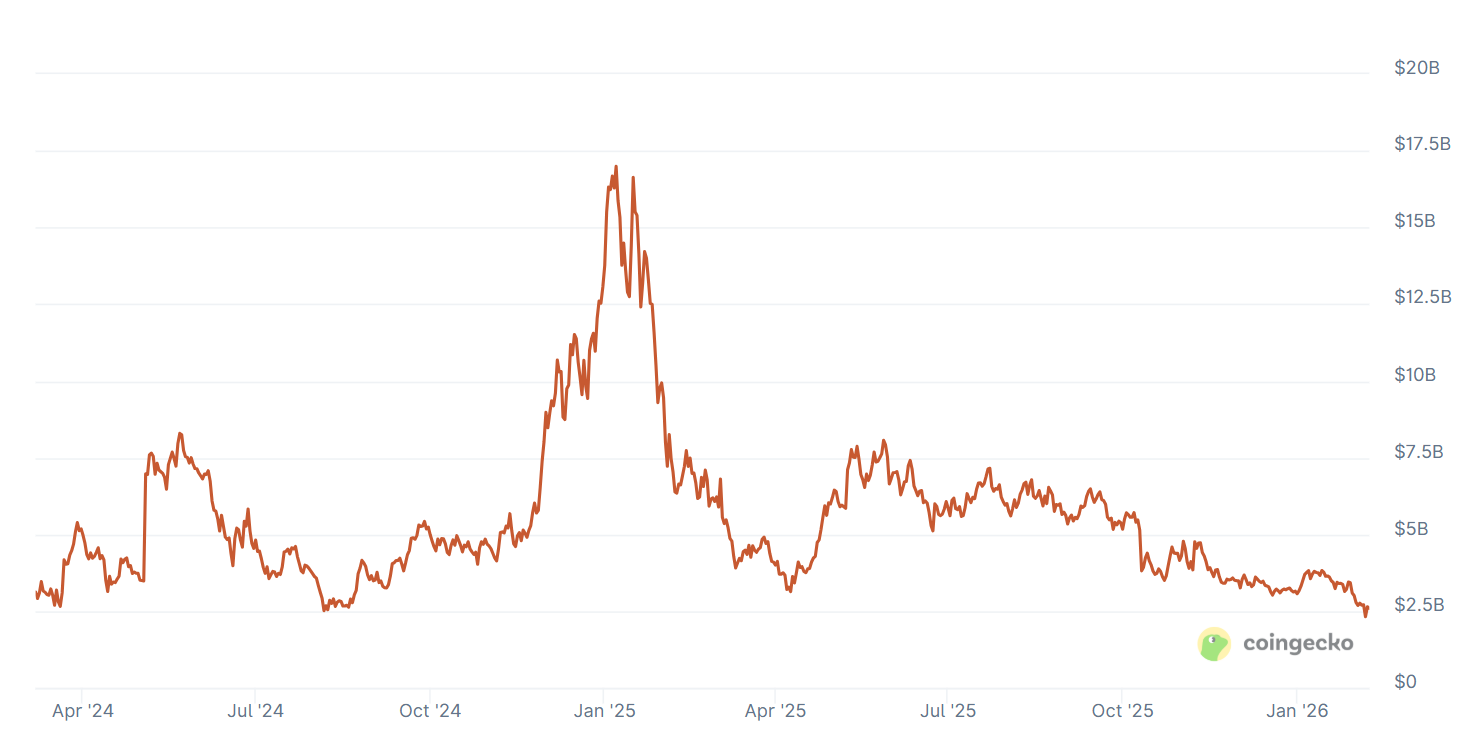
The collision here is not theoretical. According to GoinGecko, the AI agent sector currently has a market value of around $2.7 Billion, down sharply from peaks above $15 Billion in early 2025 as the market separates genuine utility from hype.
But beneath price movements, actual usage is still growing. In late October 2025, the number of transactions between AI agents using a protocol developed by Coinbase - x402 - grew by more than 4300% to 957,000 in just a week.
Agents are now operating across DeFi, NFT platforms, and prediction markets. They are small-scale for now and exist in controlled environments with limited autonomy. But the foundation is real, and the direction is clear: blockchains are no longer just for people.
AI models depend on huge amounts of underlying data. The systems powering everything from image generation to large language models (LLMs) have been trained on text, images and code from across the internet - often without consent, compensation, or even awareness from the original creators.
This has led to tension. Artists find their work reproduced in AI outputs. Writers see their texts embedded in training sets. Developers discover their code repurposed without any credit. The question of who owns what, who gets paid, and who gave permission has moved from an abstract debate to active regulatory pressure.
Blockchain keeps getting pulled into this issue, but not as a solution for hosting data, as this would be impractical and very expensive. Rather, it could be used as a way to track rights and enforce data usage. The idea is simple: use blockchain as a ledger to record who contributed what, manage permissions, and coordinate payments through smart contracts when that data is used.
Several projects are already testing this model. Some are building marketplaces where contributors can license their work to AI developers, with smart contracts automating royalties. Others are creating systems like Ocean Protocol that create records of data - when they were created, who created them - making it possible to trace which data went into which models.
The goal is not to decentralise AI itself, but to make participation in the development of AI models more transparent and accountable.
The appeal here is clear: if blockchain can create a verifiable record of contribution, it could help address any questions of ownership and compensation.
In reality, verifying that data was actually used, rather than just registered on-chain, remains difficult. Legal frameworks still dominate the space, meaning courts and regulators, not smart contracts, will likely decide how data rights work. And, markets for ‘data’ are hard to quantify when the value of any piece of data depends on context, quality, and how it’s combined with others.
What blockchain does offer is coordination. It provides a space where contributors, developers and users can agree on terms, track usage, and settle payments without relying on any single institution to enforce the rules.
Whether this is currently enough to reshape how AI training works is still up in the air. But the pressure is real, and blockchain’s role here is about practicality: it’s being tested because the current system doesn’t work.
The question of what goes into AI models is only half of the issue. The other half is what comes out.
AI now produces content at a large scale, and as that material floods the internet, a new problem emerges: how do you know that what you’re looking at is real, where it has come from, and has it been altered?
Blockchain is being used in much the same way as it’s used for inputs: as a ledger. When an AI system generates an output, that output can be logged on-chain along with information about how it was created. The blockchain doesn’t track whether the content is accurate or trustworthy - it simply creates a record of where it came from and when.
This distinction is important. Blockchain doesn’t make AI honest, but it does make AI accountable.
This matters most when you need to know where something has come from. A legal document generated by AI can include a permanent record showing who generated it and when. A news article can be flagged as AI-written. A company can log which AI system accessed any customer data to satisfy privacy regulators.
But the same constraints apply. Recording something on-chain doesn’t make it true - only that the record can’t be changed.
What blockchain offers is transparency. The ability to trace how something was made, when, and by what system.
Fully decentralised AI is unlikely. Training large models requires massive data centres and expensive hardware. This centralises it by default, a problem blockchain can’t solve.
Pantera Capital notes for crypto that ‘2026 will see brutal pruning. In each major asset class, only one or two players will dominate’. AI tokens are likely to follow this trend. What remains will be projects with real usage.
AI agents will keep growing. Andressen Horowitz predicts agents in 2026 will be ‘paying each other for data, GPU time, or API calls instantly and permissionlessly’, meaning agents will be able to automatically pay for the resources they need without human approval. But, they’ll still be constrained by human-set rules. Autonomy scales, judgement does not.
For data and verification, adoption depends on levels of pressure. Silicon Valley Bank notes that ‘for every VC dollar invested into crypto companies in 2025, 40 cents went to AI products’, up from just 18 cents the year before. Legal frameworks will dominate, blockchain will offer coordination tools - not enforcement.
The core tension still remains: AI centralises power. Blockchain can’t change that, but it can change who participates and who benefits.
AI and blockchain collide because AI creates problems - trust, control, attribution - that blockchains are built to solve.